CSCA · 15 min read · November 19, 2026
CSCA STEM Chinese vs Humanities Chinese: Differences, Syllabus & How to Choose
Not sure whether to take CSCA STEM Chinese or Humanities Chinese? Learn about the differences, subject areas, examination format, and preparation strategies to choose the right Professional Chinese track for your intended major and university.
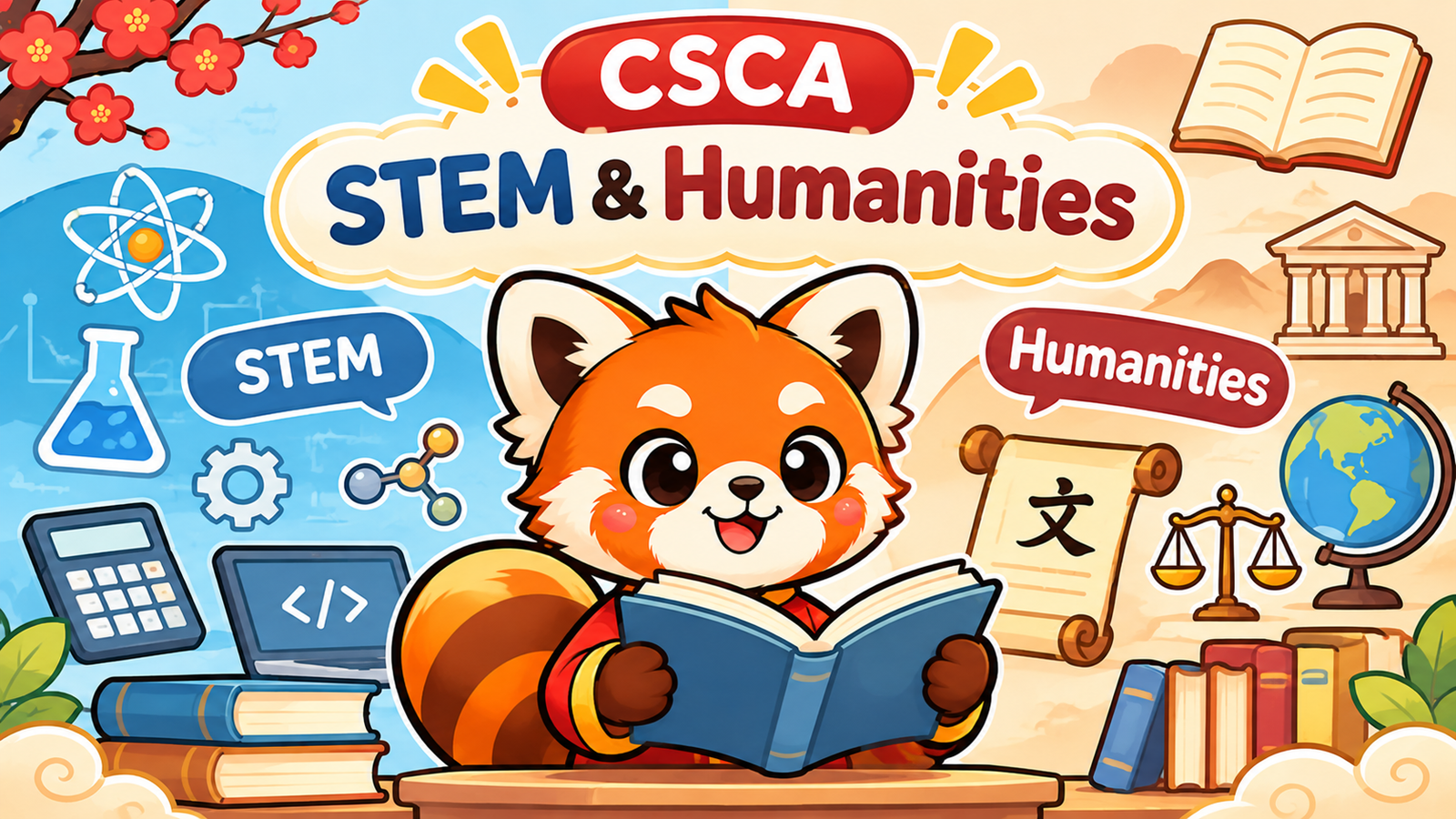
Planning to pursue an undergraduate degree in China? In addition to Mathematics, Physics, and Chemistry, there is another CSCA examination you should understand: Professional Chinese.
Professional Chinese has two categories: STEM Chinese (理科中文) and Humanities Chinese (文科中文).
But what is the difference between them? Should Computer Science applicants take STEM Chinese? What about students applying for Business, Economics, or International Relations?
Choosing the correct category is important because both examinations cover different academic contexts and vocabulary.
In this guide, we will explore the differences between STEM Chinese and Humanities Chinese, their examination content, exam format, and how to choose the right track based on your intended major and target university.
1. What Is CSCA Professional Chinese?
CSCA Professional Chinese is an academic Mandarin examination designed to evaluate whether international applicants can understand and use Chinese in university-level academic environments.
Unlike everyday conversational Mandarin, Professional Chinese focuses on language used in academic contexts related to a student's intended field of study.
Candidates are expected to demonstrate the ability to:
Understand academic vocabulary and subject-specific terminology.
Read Chinese textbooks and academic materials.
Understand academic instructions and explanations.
Identify appropriate vocabulary and sentence structures.
Understand information presented in academic passages.
Participate in classroom discussions and express basic academic concepts in Chinese.
Based on the intended academic discipline, Professional Chinese is divided into two categories:
STEM Chinese (理科中文)
Humanities Chinese (文科中文)
Both assess academic Chinese proficiency, but their reading materials and subject contexts are different.
2. Differences Between STEM Chinese and Humanities Chinese
The main difference lies in the academic fields and contexts in which Chinese is used.
Aspect | STEM Chinese | Humanities Chinese |
|---|---|---|
Chinese name | 理科中文 | 文科中文 |
Academic field | Science and technology | Humanities and social sciences |
Main focus | Scientific terminology, formulas, scientific concepts, and technology | Academic texts, social concepts, culture, history, and humanities |
Reading contexts | Mathematics, Physics, Chemistry, Computing, and experiments | Literature, Philosophy, Law, Education, History, and Arts |
Examination language | Chinese | Chinese |
Questions | 80 | 80 |
Duration | 90 minutes | 90 minutes |
Maximum score | 100 | 100 |
Both examinations share the same format, but the academic content and reading contexts are different.
A. STEM Chinese (理科中文)
STEM Chinese is designed for students applying to Science, Technology, Engineering, and Mathematics-related programs.
It assesses the ability to understand Chinese in academic contexts involving science and technology.
Relevant fields may include:
Computer Science
Artificial Intelligence
Data Science
Mechanical Engineering
Electrical Engineering
Civil Engineering
Mathematics
Physics
Chemistry
Medicine
Biotechnology
The examination uses terminology commonly found in university textbooks, scientific explanations, formulas, experiments, and STEM-related academic materials.
For example, students should become familiar with terms such as:
函数 (hánshù) — Function
方程 (fāngchéng) — Equation
力 (lì) — Force
速度 (sùdù) — Velocity
化学反应 (huàxué fǎnyìng) — Chemical Reaction
原子 (yuánzǐ) — Atom
电流 (diànliú) — Electric Current
实验 (shíyàn) — Experiment
Beyond vocabulary recognition, you need to understand how these terms are used in academic sentences and technical explanations.
B. Humanities Chinese (文科中文)
Humanities Chinese is intended for students applying to humanities, social sciences, economics, law, and related disciplines.
It assesses the ability to understand Chinese in academic contexts involving society, culture, history, literature, and other humanities-related fields.
Relevant fields may include:
Chinese Language and Literature
International Relations
Political Science
Sociology
Law
Education
Economics
History
Philosophy
Journalism and Communication
Foreign Languages
Arts and Design
Unlike STEM Chinese, which uses more scientific and technical terminology, Humanities Chinese focuses more on academic texts related to society, history, culture, ideas, and social phenomena.
Some useful vocabulary to become familiar with includes:
文化 (wénhuà) — Culture
社会 (shèhuì) — Society
历史 (lìshǐ) — History
经济 (jīngjì) — Economics
政治 (zhèngzhì) — Politics
法律 (fǎlǜ) — Law
教育 (jiàoyù) — Education
哲学 (zhéxué) — Philosophy
文学 (wénxué) — Literature
发展 (fāzhǎn) — Development
You should also develop the ability to understand arguments, cause-and-effect relationships, main ideas, and conclusions within academic passages.
3. CSCA Professional Chinese Exam Format
Although STEM Chinese and Humanities Chinese have different subject content, both examinations follow the same format.
Information | Details |
|---|---|
Number of questions | 80 |
Examination duration | 90 minutes |
Maximum score | 100 |
Question type | Multiple choice, single answer |
Examination language | Chinese |
Examination tracks | STEM Chinese / Humanities Chinese |
With 80 questions in 90 minutes, you have an average of approximately 67.5 seconds per question.
Reading speed and the ability to understand Chinese efficiently are therefore important parts of your preparation.
The Six Main CSCA Professional Chinese Question Types
According to the published CSCA syllabus, there are six main question types you should understand:
1. Chinese Character Recognition (识解汉字)
Tests your ability to recognize and understand Chinese characters in context.
You need to understand character forms, pronunciation, meanings, and differences between similar-looking characters or words.
2. Word Selection (选词填空)
Requires you to choose the most appropriate vocabulary to complete a sentence or passage.
Understanding word meanings, grammar, collocations, and sentence context is essential.
3. Word-Usage Discrimination (辨析词语)
Tests your ability to distinguish between similar words or expressions that have different meanings, usage patterns, or contexts.
4. Paragraph Completion (选词成段)
Tests your ability to select suitable words or expressions to complete a paragraph with logical flow and consistent meaning.
5. Sentence Completion (补全语句)
Requires you to complete sentences using the most appropriate expressions based on grammar and meaning.
6. Reading Comprehension (阅读理解)
Tests your ability to understand Chinese passages, identify important information, recognize main ideas, and draw conclusions based on the text.
Both examination tracks use these six question types. The main difference is the subject matter and academic context of the reading materials.
The official syllabus does not establish a separate question-count or percentage weighting for each question type, so preparation should cover all six.
4. CSCA STEM Chinese Syllabus and Examination Scope
According to the 2025 CSCA STEM Chinese syllabus, the examination content can be understood through three main areas.
A. Basic Mathematics and Science Concepts
This area covers fundamental mathematical and scientific concepts commonly used in academic learning.
Topics include:
Mathematical symbols and terminology.
Reading and understanding formulas.
Physical laws.
Chemical equations and reactions.
Basic experimental terminology.
B. Professional Course Content
This area focuses on the use of Chinese in academic materials related to STEM disciplines.
Topics may include:
Basic concepts in university-level mathematics.
Fundamental university physics principles.
Basic chemistry knowledge.
Computer programming terminology.
This means you need to understand academic STEM vocabulary, not just general Chinese expressions.
C. Academic Applications
This area involves using Chinese in academic learning and university-related situations.
Topics include:
Describing experimental processes.
Understanding graphs and data tables.
Reading academic articles and texts.
Participating in classroom discussions.
Understanding scientific explanations.
5. CSCA Humanities Chinese Syllabus and Examination Scope
Humanities Chinese uses academic reading materials related to the humanities and social sciences.
According to the 2025 CSCA Humanities Chinese syllabus, relevant subject areas include:
Literature
Philosophy
Law
Education
History
Arts
Related academic disciplines also include Chinese Language and Literature, Political Science, Sociology, Ethnology, Foreign Languages, Journalism and Communication, Music, Dance, Theatre and Film, Fine Arts, and Design.
Skills You Should Develop
For Humanities Chinese, focus on developing the following abilities.
1. Understanding Academic Texts
Become familiar with formal written Chinese and the language structures commonly found in academic materials.
2. Identifying Main Ideas
Understand the central argument and important information in a passage.
3. Recognizing Arguments
Identify opinions, supporting reasons, cause-and-effect relationships, and conclusions.
4. Understanding Vocabulary in Context
Distinguish similar words and determine their appropriate meanings based on the context.
5. Reading Efficiently
Practise skimming and scanning to identify important information without repeatedly reading every sentence.
6. How to Choose Between STEM Chinese and Humanities Chinese
This is one of the most important decisions to make before registering for the CSCA.
You should not choose a track based only on the general name of your major or personal assumptions. Always check the official admission requirements of your target universities.
The following table provides an initial reference:
Intended major | Generally relevant track |
|---|---|
Computer Science | STEM Chinese |
Artificial Intelligence | STEM Chinese |
Data Science | STEM Chinese |
Engineering | STEM Chinese |
Mathematics | STEM Chinese |
Physics | STEM Chinese |
Chemistry | STEM Chinese |
Medicine | STEM Chinese |
Business Administration | Humanities Chinese |
Economics | Humanities Chinese |
International Relations | Humanities Chinese |
Law | Humanities Chinese |
Sociology | Humanities Chinese |
History | Humanities Chinese |
Journalism | Humanities Chinese |
This is a general academic-field guide, not a universal list of official university requirements.
Four Steps to Choosing the Right Track
Step 1: Identify your intended major.
Determine which undergraduate program you want to pursue in China.
Step 2: Shortlist your target universities.
Create a list of universities you plan to apply to, including alternative choices.
Step 3: Review each university's admission guide.
Look for the Professional Chinese requirement and confirm whether you need STEM Chinese or Humanities Chinese.
Step 4: Confirm the requirement before registering.
If the requirements are unclear, contact the university's international admissions office or seek guidance from a team familiar with CSCA requirements.
You can also refer to Tiance Mandarin's CSCA Subjects by Major Directory as an initial reference.
7. Is CSCA Professional Chinese the Same as HSK?
No. They serve different purposes.
HSK and CSCA Professional Chinese assess different aspects of Mandarin proficiency.
Aspect | HSK | CSCA Professional Chinese |
|---|---|---|
Main focus | General Chinese language proficiency | Academic Chinese relevant to a field of study |
Content | Vocabulary, grammar, reading, and language abilities according to the examination level | Academic Mandarin in STEM or Humanities contexts |
Context | Everyday communication and other general language contexts | Textbooks, academic concepts, scientific or humanities texts |
Purpose | Measure general Chinese proficiency | Evaluate readiness to use Chinese in academic learning |
Categories | Based on HSK levels | STEM Chinese or Humanities Chinese |
Having a strong general Mandarin foundation can certainly help with Professional Chinese preparation.
However, do not automatically assume that an HSK certificate replaces the CSCA Professional Chinese examination. Any exemption must be confirmed with your target university.
8. Preparation Tips for CSCA STEM and Humanities Chinese
Although both examinations share the same format, your study strategy should reflect the academic context of your chosen track.
STEM Chinese Preparation Tips
1. Build Academic STEM Vocabulary
Study mathematical, physics, chemistry, and technology terminology together with pronunciation, meanings, and usage examples.
2. Practise Reading Formulas and Scientific Explanations
Develop your ability to understand relationships between formulas, symbols, units, and Chinese explanations.
3. Learn Programming and Experimental Terminology
Students applying for Computer Science and other STEM disciplines should become familiar with technology, data, programming, and laboratory terminology.
4. Practise Reading Graphs and Data Tables
Become familiar with understanding numerical information presented in Chinese.
5. Read Academic STEM Texts
Start with short explanations of scientific and technological concepts in Chinese, then gradually move to longer academic passages.
Humanities Chinese Preparation Tips
1. Expand Your Humanities Vocabulary
Study vocabulary related to history, literature, culture, politics, law, economics, and society.
2. Read More Academic Texts
Become familiar with formal Chinese writing by reading informative articles and academic-style passages.
3. Understand Relationships Between Ideas
Practise identifying cause and effect, comparisons, opinions, and conclusions in a passage.
4. Learn Differences Between Similar Words
Pay attention to words with similar meanings but different usage, contexts, or nuances.
5. Improve Your Reading Speed
Practise skimming and scanning to identify main ideas and specific information efficiently.
Strategies That Apply to Both Tracks
Regardless of which category you choose, practise completing questions under time constraints.
With approximately 67.5 seconds per question, you need to develop vocabulary recognition, contextual understanding, and efficient decision-making without sacrificing accuracy.
Evaluate your performance across all six question types to identify areas that still need improvement.
9. Prepare for CSCA STEM & Humanities with Tiance Mandarin
Having difficulty understanding academic vocabulary or reading Chinese texts related to your intended field?
Tiance Mandarin offers CSCA STEM Chinese and Humanities Chinese preparation programs for students planning to pursue undergraduate studies in China.
What will you learn?
Academic Mandarin vocabulary for STEM or Humanities.
Chinese terminology and texts related to the examination.
Reading comprehension and understanding Chinese instructions.
Practice questions with explanations.
Test-taking strategies and time management.
Mock examination preparation.
Why choose Tiance Mandarin?
Online classes through Zoom.
Small group classes of up to 6 students or private lessons.
Structured learning of important vocabulary and concepts.
Practice questions and detailed explanations.
Past papers and mock tests.
Class recordings, notes, and vocabulary lists.
The preparation program consists of 10 sessions × 90 minutes, giving students a total of 15 hours of learning.
Classes start from Rp145,000 per hour.
Ready to Prepare for CSCA Professional Chinese?
Do not focus only on memorizing Chinese vocabulary. Develop the ability to use Mandarin to understand academic materials related to your intended major.
Choose the correct examination track based on your university's requirements, then prepare systematically with Tiance Mandarin.
Start preparing for CSCA STEM Chinese or Humanities Chinese today!
WhatsApp: +62 851-6666-4818
Frequently Asked Questions About CSCA STEM & Humanities Chinese
1. What is the difference between STEM Chinese and Humanities Chinese?
STEM Chinese (理科中文) focuses on academic Mandarin used in science and technology, while Humanities Chinese (文科中文) focuses on humanities and social-science contexts.
2. How many questions are in CSCA Professional Chinese?
Both categories consist of 80 multiple-choice questions, with one correct answer per question.
3. How long is the CSCA STEM and Humanities Chinese examination?
Each examination lasts 90 minutes.
4. Is CSCA Professional Chinese available in English?
No. Both examination categories are conducted entirely in Chinese.
5. Should Computer Science students take STEM Chinese?
STEM Chinese is generally the relevant category for Computer Science. However, you should still confirm the requirements of your target university.
6. Should Business students take Humanities Chinese?
Humanities Chinese is generally relevant to Business and Economics, but the final requirement depends on the target university.
7. Can HSK replace CSCA Professional Chinese?
Do not assume that they are interchangeable. Check the exemption policies of your target university.
8. Where can I prepare for CSCA STEM and Humanities Chinese?
Tiance Mandarin offers online preparation classes through Zoom, with small groups of up to 6 students and private lesson options.
Official references and additional information: